
I've shot a lot of landscapes over the years – and these are, in my view, the best cameras for landscape photography. You might think that shooting landscapes is a fairly straightforward process compared to the challenge of capturing fast-moving wildlife or fleeting street moments, but bagging a great landscape has challenges all of its own. You need the right kit for the job.
Ideally, you want a camera with a high-resolution sensor that can capture plenty of detail, as well as wide dynamic range for retaining maximum information in the highlights and shadows. Having access to a broad range of wide-angle lenses is also a high priority – as you'll see, I've picked mostly mirrorless cameras and DSLRs with broad lens ranges.
I've included plenty of new releases, but have also made sure to add in some older and more affordable cameras that I believe still offer excellent value for landscape photographers. Scroll to the bottom of this page for more detail on how I've made my picks and how we test cameras – otherwise, let's dive in.


Phil used to work on What Digital Camera magazine, and was the editor of Techradar's camera channel. He is an accomplished photographer – and although his passion is shooting cars, he also loves shooting landscapes (see his portfolio of seascapes here).
The Quick List

The new highest-resolution full-frame camera, the Sony A7R VI is one of the most capable full-frame cameras on the market, and is capable of producing a simply stunning amount of detail in images.
Read more below

For landscapes, a huge sensor is the dream! This mirrorless medium-format camera is more lightweight, portable, useable and affordable than traditional medium-format cameras – and blows away the competition with a gorgeous 102MP sensor.
Read more below

With its 45MP sensor, the EOS R5 is one of Canon's highest-resolution cameras. It's party piece is that it can deliver huge 400MP images via pixel-shift technology – which the newer and pricier EOS R5 Mark II can't do. Perfect for landscapes where there is zero movement!
Read more below

The Z7 II is our pick if you want a Nikon camera for landscapes. It has an impressive 45MP full-frame sensor, and the ever-improving Z-mount lens range offers plenty of fantastic optics. The Z7 II offers better value for landscapes than the Z8 or Z9, which are built for speed.
Read more below

This is undoubtedly one of the best DSLRs ever made – and is now something of a bargain for such a professional, full-frame camera. The weather-sealing is best in class, and you'll find lots of affordable F-mount lenses still available, particularly second hand.
Read more below

The Fujifilm X100VI is a compact camera with a fixed wide-angle lens that makes it a great option for hiking or cycling through the countryside. With retro styling, it delivers great images from its 40MP APS-C sensor – though it often sells out due to high demand!
Best cameras for landscape photography
Why you can trust Digital Camera World Our expert reviewers spend hours testing and comparing products and services so you can choose the best for you. Find out how we test.
Best camera for landscapes overall

When it comes to landscape photography, resolution is king. The more pixels you can get, the bigger and better prints you can make, the more fantastic detail you can capture. The Sony A7R VI is the new king of resolution in full-frame cameras, boasting an incredible 66.8MP on its stacked sensor. The only way to get more pixels is to go medium format – see the next entry for more on that.
As Gareth found in our review, all those pixels make the Sony A7R VI capable of resolving a simply stunning level of detail in its images. Its dynamic range in RAW is top-tier, and Sony’s dynamic range optimizer has been boosted to eight selectable levels, ensuring you can capture the maximum detail in highlights and shadows.
If 66.8MP isn't enough for you, Sony also offers 270MP pixel shift shooting, producing multiple exposures which can be combined in Sony's Imaging Edge Software to produce a single ultra high-res file. Or, if you prefer to work in JPEG, Sony also offers a selection of Creative Looks. They're not a patch on Fuji's Film Simulations or Panasonic's in-camera LUTs, but they're not bad.
The only reason you might not want to use the Sony A7R VI for landscapes is that it could be quite overpowered for your needs. Sony has given this camera a serious kick up the backside in terms of its speed, adding 30fps shooting with a big shot buffer and pre-capture (the previous A7R V could only manage 10fps with its electronic shutter). This is paired with one of the best autofocus systems in the business, augmented with subject recognition, and all this functionality does mean that the Sony A7R VI is a very expensive proposition.
If you don't need all that speed and don't mind a small resolution cut, you could also consider the A7R V or A7R IV, both of which use a 61MP sensor and can be picked up for a smaller (though still not small) outlay. Still, I feel confident saying that the Sony A7R VI is the best full-frame camera you can get for landscapes right now, and my pick for the best landscape camera overall.
Read our full Sony A7R VI review for more details
Best medium format camera for landscapes

For shooting landscapes, a large medium format sensor is the dream, but the expense and the bulk puts it beyond the reach of the majority of photographers. That's why Fujifilm's GFX series has been such a hit – these mirrorless medium format cameras are more lightweight, portable and useable than more traditional medium format cameras, and while the cameras are still expensive, they're cheaper than the likes of Hasselblad.
The GFX100S II is a superb option for landscape photography, offering sublime quality thanks to its 102MP sensor. It's not quite the top dog of the series, but is a little more affordable than the flagship GFX 100 II, and probably makes more sense as a purchase for most landscape shooters.
Despite boasting a larger sensor than full-frame rivals, the GFX 100S II isn't all that different in terms of size and weight, and its price tag is also not wildly beyond that of a flagship Sony or Canon mirrorless model. Image quality is quite simply spectacular – a new ISO 80 mode allows you to maximise detail, and you can crop in to your heart's content without losing quality, effectively giving you multiple lenses in one! There's also a pixel-shift mode that allows you to create images up to 400MP in resolution (as long as your subject doesn't move).
Autofocus has also been majorly improved from the previous GFX 100S – it's not up to the level of full-frame mirrorless cameras, but for landscape shooting this isn't as much of an issue.
Read our full Fujifilm GFX 100S II review for more details
Best Canon camera for landscapes

One of Canon's most game-changing mirrorless cameras, the EOS R5 is an obvious choice for landscape photography thanks to its 45MP sensor – the highest resolution of any current Canon product. However, the R5 has a trick up its sleeve: it can actually shoot 400MP images!
Thanks to the magic of pixel-shift, powered by the camera's in-body image stabilization system, the surface area of the sensor is artificially increased to deliver an almost tenfold boost to resolution. The caveat, however, is that both camera and scene have to be completely still with no movement whatsoever – which includes water and trees or foliage (so it is not ideal for all landscape shots).
The R5 also employs Canon's cutting-edge line of RF mount lenses, but it can also use EF mount DSLR lenses with native performance using an EF-EOS R adaptor – giving it one of the richest ranges of optics on the market.
A successor to the Canon EOS R5 has since been released, the Canon EOS R5 Mark II. It's an absolute monster of a camera, packing a new Digic Accelerator chip that works in tandem with the processor to deliver ultra-fast focusing speeds and preternatural AI-powered subject-tracking.
However, the majority of its improvements aren't all that useful for landscape photographers, who don't need all that AF speed – and it even loses the 400MP pixel-shift mode in favour of (admittedly impressive) 180MP in-camera upscaling. Then there's also the fact that the EOS R5 Mark II is currently almost double the already considerable price of the EOS R5. The Mark II is undoubtedly a hell of a camera – but for our money, landscape photographers will get better value from the original EOS R5.
Read our full Canon EOS R5 review for more details
Best Nikon camera for landscapes

The Nikon Z7 II is an older camera in the Nikon mirrorless range, but there's still lots to attract the serious landscape photographer. The 45.7-megapixel full-frame sensor delivers brilliant images as you'd expect, while it's a bit lighter and more compact than the Z7 II's DSLR stablemate, the D850, making it a bit easier to live with if you're going to be lugging it about all day.
The electronic viewfinder is very good, but bear in mind that rivals like the EOS R5 and the Sony Alpha A7R VI enjoy even better resolutions. Autofocus is more than up to the job when it comes to landscapes as well – there are better systems out there, but focusing is swift and we were pleased to note that it achieves focus even in the poorest of conditions.
There's a growing range of dedicated Z series mirrorless lenses available for the Z7 II, while the FTZ II adapter means you can choose from a huge back catalogue of Nikon F-mount lenses should you prefer. Though it's not as new as the Nikon Z8 or Z9, cameras that focus more on sports and speed, the Z7 II represents better value for the landscape photographer. It's still also one of the higher-res cameras in the Nikon Z stable, making it a better option for landscapes than the newer Z6 III or Z5 II, both of which offer a top-line resolution of 24MP.
Read our full Nikon Z7 II review for more details
Best DSLR for landscapes

Mirrorless camera fans will often complain about the size and weight of DSLRs, and they have a point. The Nikon D850 is a big bruiser of a camera compared to the Nikon Z models.
But this size works in your favor if you're shooting with big, heavy lenses, and most pro lenses are big and heavy! This is a handling factor that many mirrorless users don't take into account. Being a DSLR, the D850 has a bright, clear optical viewfinder that many landscape photographers still prefer over a digital display, no matter how good the latter.
The D850's 45.7MP sensor produces quite a superb image quality, yet it can still maintain a shooting speed of 7fps. The D850 has an amazing battery life of 1840 shots – far more than any mirrorless rivals – and it comes with two memory card slots; one for an XQD/CFexpress card and one for regular SD/SDHC/SDXC.
Read our full Nikon D850 review for more details
Best compact camera for landscapes
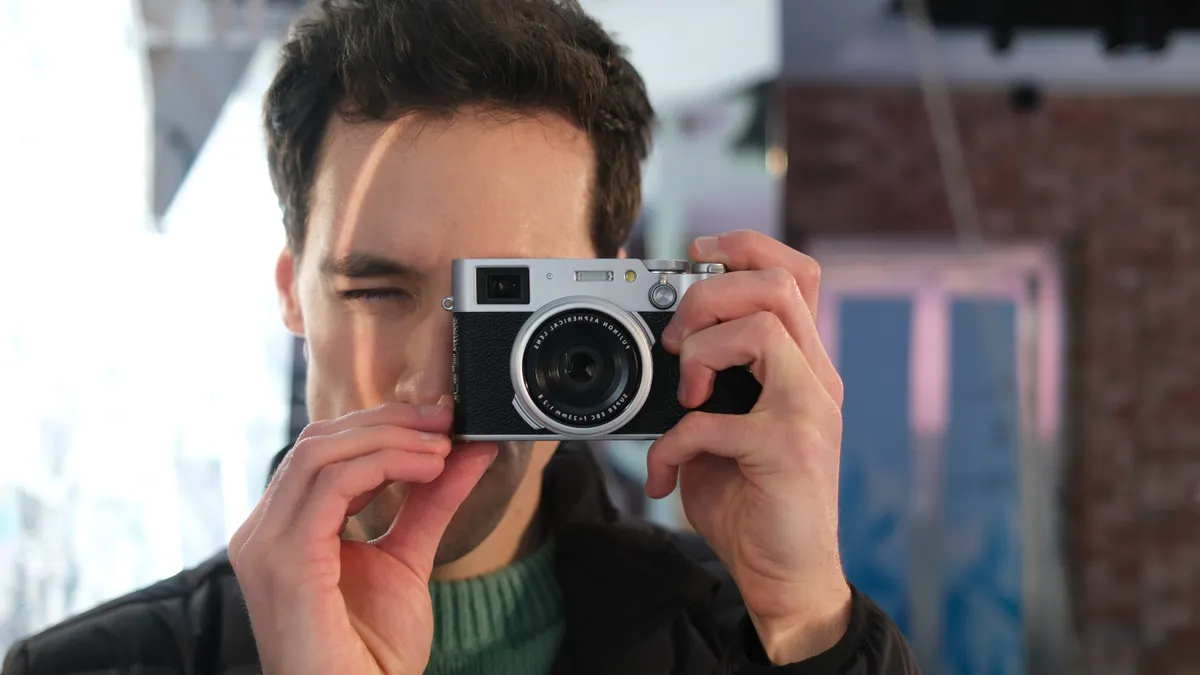
The Fujifilm X100VI is styled like a classic rangefinder compact camera - and the appeal of to the landscape photographer it is more portable than interchangeable lenses – making it great for hiking trip, say. It delivers great image quality from its 40MP APS-C-sized sensor, and allows you to take advantage of Fujifilm's stylish 'Film Simulation' modes to create images with particular analog looks.
The tilting touchscreen on the back makes this camera much easier to use at awkward angles – allowing you to get down low to fill the foreground with a flower or a rock. The lens on the front is a fixed prime with an equivalent focal length of 35mm. You might think this is quite limiting, but honestly, I think it's better than going for a zoom. You'll get much better image quality – especially because the X100VI has a larger sensor than most zoom compacts – and the limitation of a fixed focal length can be great for forcing yourself to think creatively, moving your feet and positioning rather than just zooming in and out.
The X100VI has external lens aperture, shutter speed, and ISO dials which, that those from the 35mm film SLR era (or those who appreciate a throwback) will love. The X100VI uses a hybrid optical/digital viewfinder that's great for use in lowlight. And of course, we shouldn't forget the looks, which have helped make this incredibly sought-after.
Do note that you need to buy an optional kit in order to make this camera fully-weatherproof – which uses a filter to seal the lens against the elements.
Read our full Fujifilm X100VI review
Lab Data
As part of our review process, we collect lab data on each camera in the guide, these show the resolution, dynamic range, and noise from each camera's sensors expressed as a value – for more info on these numbers check out the table footer. You can see how my picks for this guide compare below.
How to choose the best camera for landscapes
There are a number of things to take into account when choosing a camera for landscape photography - your budget is key, of course, but also you need to decide how much kit you want to take with you. A good landscape camera needs a few very specific things.
More than most other genres, landscape photographers need resolution and a large sensor. Lots of megapixels on a large sensor mean you can capture all of the tones and details in a big, gorgeous landscape scene, crop in if you need to, and print large-scale. You don't need to worry about features like burst mode or super-fast autofocus as you won't be shooting anything fast-moving.
Weatherproofing is also important, as landscape shooting can often involve long treks in inclement conditions. The physical weight of the camera and lens can also be crucial. If you're going to have to carry a kit through the desert, the forest or wherever else, you probably don't want something that becomes a huge burden on your back..
How we test cameras

We test cameras both in carefully controlled lab conditions where we think appropriate - but for cameras for landscapes, the capabilities of a camera in real-world conditions are just as important. We therefore try out cameras in a range of shooting conditions, analyzing the images taken and comparing them to the hundreds of other models we have reviewed over the years.
For interchangeable lens cameras, our Lab Manager, Ben Andrews, measures resolution, dynamic range, and signal-to-noise ratio – which we can then compare to results in the huge database of other cameras we have tested. Resolution is measured using ISO resolution charts, dynamic range is measured using DxO Analyzer test equipment, and DxO Analyzer is also used for noise analysis across the camera's ISO range.
FAQs
How important is sensor size?
Having lots of megapixels to capture of the detail of a mountain scene are important, up to a point. But it is the overall quality of the image that counts. So almost as important is the size of the sensor. We therefore recommend that you at least go for a camera with an APS-C sensor. But better still opt for a full-frame sensor that is over twice the size. For ultimate image detail however, you can go large and use a medium format camera. The downside, however, is that the bigger the sensor, the bigger the camera and the lenses…
What does weatherproofing on a camera actually mean?
Protecting your camera against rain, condensation, and dust is an important consideration if you are using it outdoors in all weathers. Unfortunately, it is not feasible to make mirrorless or DSLR cameras fully waterproof, as the interchangeable lenses, the memory card slots, and battery compartments are all weak points in the construction. However, cameras come with varying degrees of weatherproofing - thanks to the use of rubber-like seals at key joints and openings in the construction of the body. All the cameras in our selection have weather sealing – but generally the more professional the camera, the better this weather sealing will be. The one compact camera in our selection (the Fujifilm X100VI) doesn't have a removable lens – however to make it weather-sealed you need to purchase an optional Weather Resistant Kit which comprises of an adapter ring and protective filter to attach to the front of the lens.
What's the best lens for landscape?
We usually think of wide-angle lenses as being the best option for landscape photography - as these allow you to include a wider sweep of a scene. On a full-frame camera, any lens with a focal length of 35mm or less is considered to be a wide-angle (that's 24mm or less on an APS-C camera, or 45mm or less on a medium format camera). A wide-angle zoom is a great all-round option for landscapes - allowing you to crop your angle of view to fit the landscape. A good all-round choice would be 16-35mm on a full-frame camera, or a 10-24mm on an APS-C camera.
However, telephoto lenses can be just as useful for landscape photography - allowing you to pull out details from the scene that are more interesting than showing the whole view.
