Digital Camera World Verdict
The Leofoto Armour LN-284CT + NB-40 tripod kit took me by complete surprise. It takes the saying ‘if a deal looks too good to be true, then it probably is’, and completely turns it on its head. In fact, the full, luxury carbon fiber kit that also converts into a monopod costs barely any more than the ‘professional’ dual-panning ball head on its own in the UK, and isn’t much pricier in various other world regions. How can you resist?
Reasons to buy
- +
Premium quality
- +
Excellent performance
- +
Travel friendly
- +
Monopod conversion
- +
Amazingly great value
Reasons to avoid
- -
Center column not splitable
- -
QR plate obscures bubble level
Why you can trust Digital Camera World Our expert reviewers spend hours testing and comparing products and services so you can choose the best for you. Find out how we test.
Based in China and operating in more than 40 countries around the world, Leofoto was founded in 2014. It’s come a long way since then, and its name has become synonymous with luxurious, pro-grade photographic supports and military-grade tactical gear, all at very reasonable prices. I was certainly very impressed last year when I extensively tested and reviewed a whole bunch of Leofoto kit, including the Leofoto Ranger LS-365C tripod legs, Leofoto LH-36LR Ball Head, Leofoto VH-30R Two-Way Head, Leofoto G2 Geared Pan Head and Leofoto PG-1 Gimbal Head.
The Leofoto Armour LN-284CT + NB-40 tripod kit is a relatively new addition to the line-up. It’s tall and robust enough to qualify as a full-sized tripod, yet folds down small with swing-up legs, more typical of modern travel tripods. It has an impressive carbon fiber construction and comes complete with a ball head that costs almost as much as the full kit if you buy it on its own. All in all, the kit is a contender as one of the best tripods for photographers, one of the best carbon fiber tripods, and maybe even one of the best travel tripods.
Leofoto Armour LN-284CT + NB-40: Specifications
Material |
Carbon fiber |
Folded height |
50.5cm / 19.9in |
Maximum operating height |
169cm / 66.5in |
Minimum operating height |
21.5cm / 8.5in |
Weight |
2.2kg / 4.9lb |
Load rating |
15kg / 33lb |
Sections per leg |
4 |
Section diameters |
28, 25, 22, 19mm |
Section clamps |
Twist locks |
Locking leg angles |
3 |
Feet |
Pads / spikes |
Case/bag included |
Padded bag |
Leofoto Armour LN-284CT + NB-40: Price
I’ve previously seen recommended retail prices for the Leofoto Armour LN-284CT + NB-40 tripod kit quoted as $325 / £250 / AU$567. At the time of writing this review, however, they’ve dropped to just $225 / £175 / AU$425, the British price being confirmed by Leofoto’s official UK distributor. That’s pretty remarkable considering that the NB-40 Professional Ball Head on its own sells for around $179 / £170 / AU$269, just £5 less in the UK.
The closest equivalent I can think of in terms of design, being a robust, full-sized carbon fiber tripod kit with travel-friendly swing-up legs and a ball head, is the 3 Legged Thing Winston 2.0 Kit, which costs around $499 / £339 / AU$629. That’s about twice the price in the USA and UK, and around 50 per cent more in Australia. That said, the Winston is taller and has a much beefier 40kg / 88lb payload rating. Anyway, let’s see what you actually get for your money.
Leofoto Armour LN-284CT + NB-40: Design & Handling
The design of this tripod kit has me in a bit of a quandary. I can’t quite decide whether it’s a full-sized tripod for photographers, a travel tripod courtesy of its reverse-folding legs, or a tripod for hybrid shooters thanks to the dual-panning mechanism in its head. Ultimately, I think it’s designed to fit the bill for all of these scenarios, as well as enrolling for a bit of monopod duty on the side.
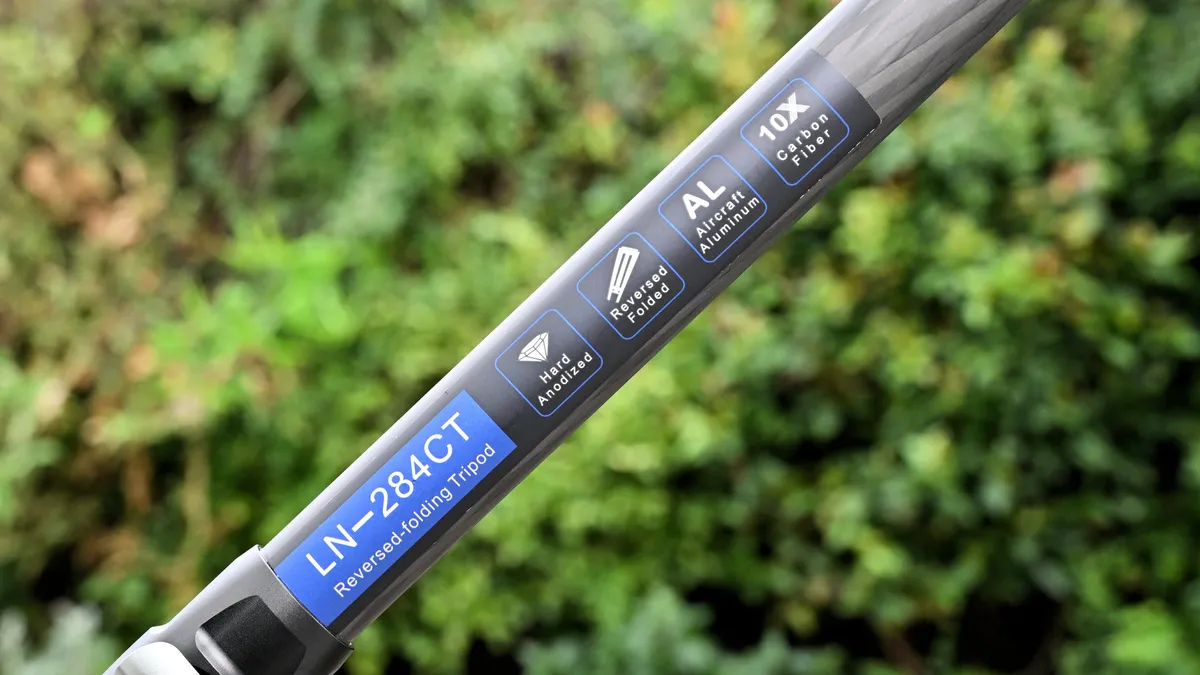
Bridging the gap between big tripods that often seem too large to take along for the journey and lightweight travel tripods that seem too flimsy, I think the Leofoto is an ideal compromise. It has 4-section legs, which enables a smaller stowage height (especially as they’re reversible), whereas 3-section legs tend to remain quite tall when folded, and 5-section legs often have very thin and spindly bottom sections. The net result is that the Leofoto uses chunky 28mm diameter outer sections that enable a strong 15kg / 33lb payload rating, along with an easily manageable carrying weight of 2.2kg / 4.9lb for the complete kit.
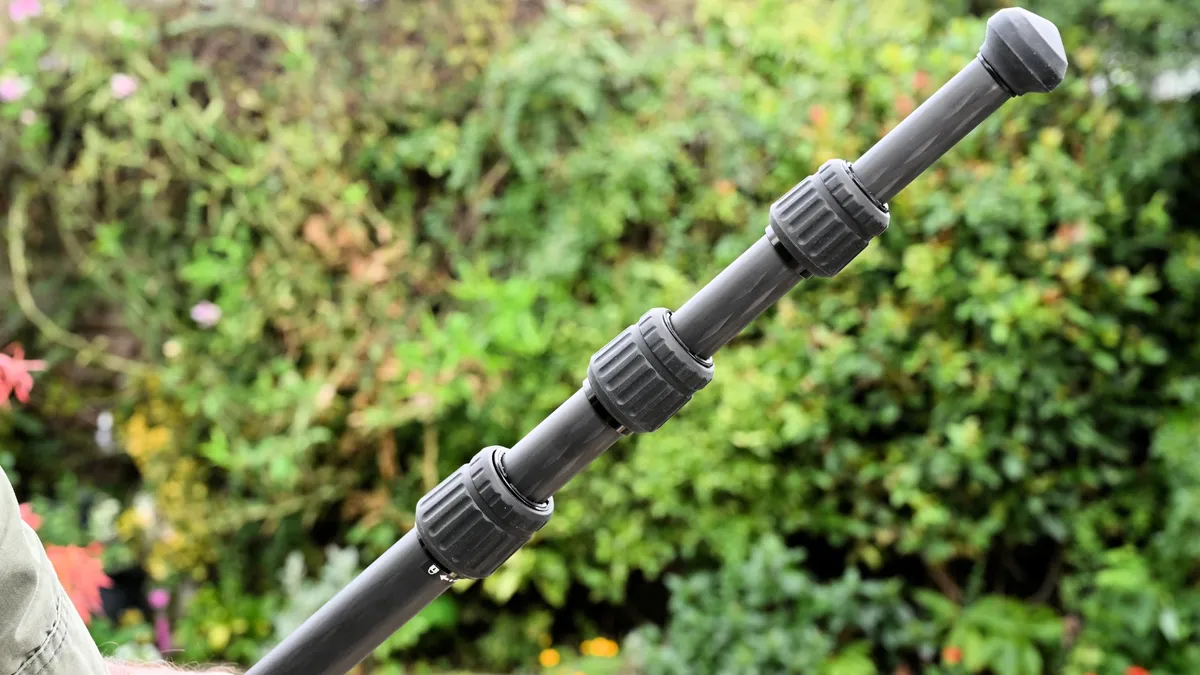
I usually prefer twist-action leg section locks to flip locks, but only if they require minimal rotation to loosen the sections and lock them again firmly in place. Most manufacturers have become very good at this, but the twist locks featured in the Leofoto are among the easiest to use that I’ve ever encountered.

One thing I always look for in a tripod is multi-angle legs. Typically, you get three lockable leg angles, and it can be a massive help when you’re working on tricky, uneven terrain or trying to cope with obstacles that you can’t move out of the way. Splaying the legs a little also gives a more stable support when you’re shooting from a fairly short height. The Leofoto obliges, with 3-angle legs and again, the mechanism for adjusting the angles is particularly quick, easy, and intuitive to use.

The center column works with similar simplicity to the other features I’ve mentioned so far. That’s just as well, as you need to extend it fully each time you fold the tripod if you want to take advantage of the reverse-folding leg action for compact stowage. To lock or loosen the center column, there’s a large rubber twist-lock just above the tripod platform, which looks similar to the twist-locks for the leg sections and works just as efficiently.

At the bottom of the center column, there’s a large weight hook. You can use this for adding ballast, which can help steady the tripod in windy outdoor weather conditions. Unlike some tripods, the Leofoto lacks a splittable center column, so you can’t turn it into a short stubby column for ultra-low-level shooting. Instead, you’ll need to unscrew the weight hook, remove the center column, invert it, and refit it. That’s all well and good if you don’t mind shooting with your camera upside down, which is less than ideal for stills and a bit of a non-starter for shooting video.

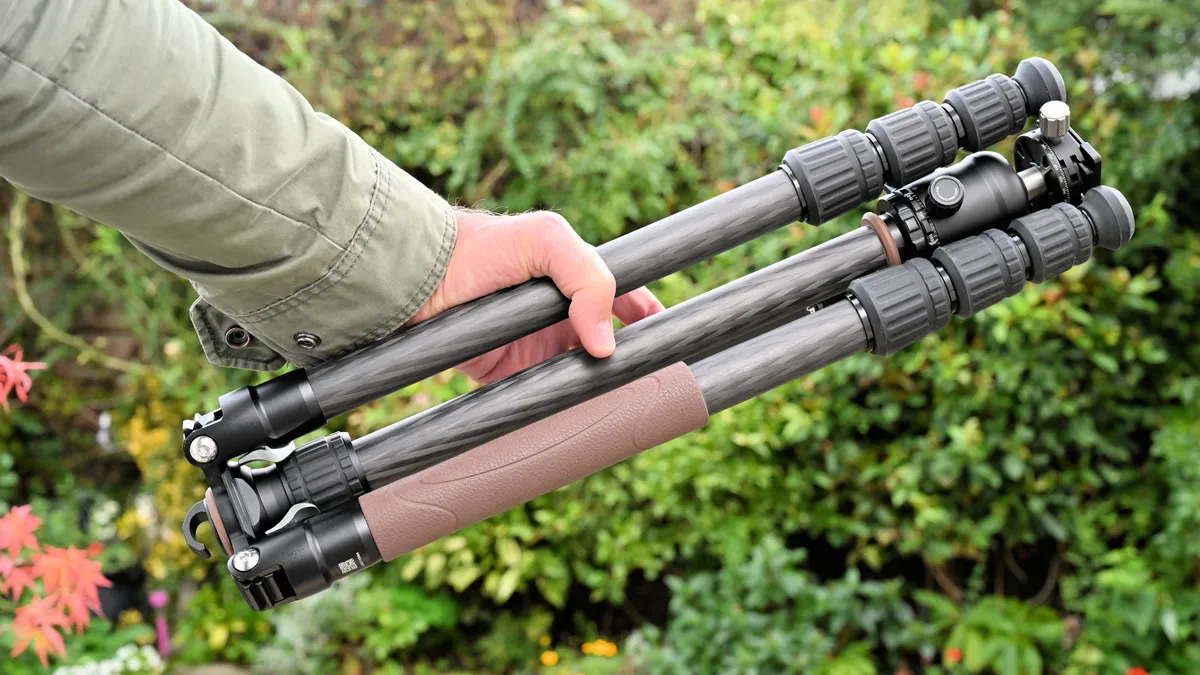
As well as inverting the center column, there’s another good reason for removing it. One of the legs (the one with the silica comfort padding, shown in the image above) unscrews from the canopy. You can then attach the top of the leg to the bottom of the removed center column, and you’ll be rewarded with a full-featured monopod. Another option is that you can remove the leg and turn the tripod into a bipod for use as a tactical support. And to keep a firm footing on any terrain, you can also unscrew the rubber pads that act as feet and replace them with stainless steel metal spikes, supplied as part of the kit.

Up on top, the kit features the Leofoto NB-40 Professional Ball Head. It’s such a seriously good head that I’d consider buying it on its own and, as I’ve mentioned, it doesn’t come cheap. It has a 51mm diameter base and 95mm height, and ensures smooth action with a large-diameter, precision-engineered 40mm ball. In fact, it has a really heavy-duty payload rating of 25kg / 55lb, far exceeding that of the tripod legs.

The head backs up its hefty payload rating with an adjustable friction damper, built into the main lock/release knob. It’s a useful addition that enables you to tailor the action of the ball head to anything from a lightweight compact camera to a pro-sized camera body with a monster telephoto lens attached. As usual, the ball joint features a cutout so that you can shoot in portrait as well as landscape orientation without needing to use an L-bracket, as well as shooting vertically upwards or downwards.

One of the smartest things about the head is that it has two panning mechanisms, which is great news for videographers, or if you want to shoot a sequence of panned stills to stitch into a panorama. The regular bottom panning mechanism works just fine if your legs are perfectly level, but that can be a chore if you’re working on uneven ground. However, if they’re not absolutely level and you’ve compensated by tilting the head, your horizon will go on the skew as soon as you start panning. This is where the secondary, upper panning mechanism comes into play, as it only requires that you level the ball head and not the legs as well.

A further leveling aid is that a bubble level is built into the Arca-Swiss compatible camera platform. It’s nice to have, but unfortunately it’s obscured when you fit the quick-release plate into the platform. The upshot is that you need to remove your camera from the tripod every time you want to use the bubble level. To be honest, though, I tend to use the virtual horizon that is featured in most cameras nowadays, which is more accurate and easier to work with.

The quick-release plate itself is another trick bit of kit. It has the usual Arca-Swiss profile but goes further by adding a strap loop and an adjustable bracket. The latter is particularly useful, as it can help to lock your camera in place on the QR plate and ensure there’s no accidental twisting.

Further reinforcing the tripod’s suitability as a travel buddy, it comes complete with a smart padded bag, similar to the one shown below. And you can also pack the metal spikes and crafty little multi-tool into the bag. The multi-tool itself is very similar to one that I use from 3 Legged Thing, and includes a flat blade, various sizes of Allen keys, a carabiner hook, and a bottle opener.

Leofoto Armour LN-284CT + NB-40: Performance
No matter how big or small, heavy or lightweight a tripod happens to be, rigidity is always a key factor. The Leofoto impressed me from the get-go, delivering rock-solid support that’s very resistant to unwanted flexing and vibrations. Moreover, its section locks, leg angle locks, and ball head are all brilliantly designed and excellently engineered, making them a joy to use.
I don’t usually like reverse-folding legs that are featured in most travel tripods these days, as they require more time and effort in setting up the tripod and folding it down again afterwards. However, the Leofoto proves that the configuration can be quick, easy, and highly effective.

The 4-section legs and full-height center column enable the tripod to stretch from its folded height of a very travel-friendly 50.5cm / 19.9in to a lofty maximum operating height of 169cm / 66.5in. Sure, the Leofoto isn’t the tallest tripod in the world, but I’m 6ft 5in and I found it perfectly tall enough for me to use without stooping, when putting my eye to the camera’s viewfinder. More importantly, the tripod’s rigidity and resistance to flexing and vibration remain excellent even with all of the leg sections and the center column fully extended.

While the tripod is perfectly tall enough as far as I’m concerned, the minimum operating height is rather too tall for my liking. Leofoto quotes it as being just 21.5cm / 8.5 in, but it's more like 49.5cm / 19.5in by my reckoning (and measuring). Sure, you can invert the center column and go right down to ground level, but do you really want to shoot out from between two of the legs with your camera upside down? I’d have liked to see a splitable center column, or a short stubby low-level adapter supplied in the kit, to enable ultra-low-level shooting with my camera the right way up.

Back on the plus side, it’s quick and easy to unscrew one of the legs and attach it to the removed center column for monopod duty. It’s easy to remember which leg it is that unscrews, because it’s the one with the silica comfort padding on it. And in terms of performance, the Leofoto works every bit as well as a monopod or bipod, as it does as a tripod.

To cap everything off, the Leofoto NB-40 Professional Ball Head that’s supplied as part of the kit is an absolute peach. The ball mechanism works a treat with its adjustable friction damper, while the dual panning mechanisms pay dividends for stills, even more so for shooting video. And as with the tripod legs, all of the adjustments are quick, easy, and intuitive.

Leofoto Armour LN-284CT + NB-40: Verdict
The Leofoto Armour LN-284CT + NB-40 tripod kit has really won me over. It’s a luxurious, high-quality 10-layer carbon fiber tripod that’s easily tall enough for me (and I’m pretty tall) yet folds down to very travel-friendly dimensions. The chunky leg sections enable superb performance with excellent resistance to flexing and vibrations, and yet the tripod feels lightweight to carry around in its smart padded bag.
The only thing I can’t decide on is whether I prefer the ‘professional’ ball head with its dual additional panning mechanisms, or the tripod legs themselves, which also convert into a useful monopod or bipod. One thing’s for sure though… the head and legs combine to make a pretty epic kit. My only slight niggles are that there’s no ultra-low-level adapter for the legs and the head’s bubble level is obscured by the QR plate.
The bottom line, in the UK at least, is that the entire kit of legs, head and accessories, all wrapped up in a padded bag, costs barely any more than the head on its own. It feels a bit like a ‘buy one get one free’ deal in the UK, and it’s also standout value for money around the world.
Features ★★★★½ |
Desirable features include 10-layer carbon fiber legs, twist-action clamps, multiple leg angles, and monopod/bipod conversion, plus a great ball head with dual panning mechanisms, but no ultra-low-level adapter. |
Design ★★★★★ |
The reverse-folding leg design with 4-section legs and a center column to enable a generous maximum operating height and a compact stowage size. It also combines a strong payload rating with a lightweight but premium construction. |
Performance ★★★★★ |
The tripod and head combine to give super-steady support at all operating heights, right up to the max with the center column fully extended. All the controls are quick, easy, and intuitive to use. |
Value ★★★★★ |
For a premium carbon fiber tripod with a professional-grade ball head, it’s spectacular value for money. |

Alternatives