Digital Camera World Verdict
The Sirui BH-60 2-in-1 Photo & Video Head is designed to cater to both stills and video capture. Sure enough, the ball action enables quick and easy setup for stills, while the fluid pan-and-tilt mode is ideal for shooting video, and there’s also a ‘transitional’ setting. However, the tilt range for stills is much more limited than a typical ball head, with no portrait orientation on the agenda, and there’s no built-in leveling base for videography. All in all, I feel the Sirui is more of a compromise than a seriously useful 2-in-1 hybrid head.
Reasons to buy
- +
2-in-1 multi-purpose stills and video tripod
- +
Ball, pan, tilt
- +
Strong load capacity
- +
5kg counterbalance
Reasons to avoid
- -
No built-in leveling
- -
Limited tilt range
- -
No portrait orientation
- -
No secondary panning plate
Why you can trust Digital Camera World Our expert reviewers spend hours testing and comparing products and services so you can choose the best for you. Find out how we test.
I encountered my first Sirui tripod about 20 years ago, and was pretty impressed at the time. The Chinese company was originally established in 2001, building a solid reputation for tripods and heads over the ensuing five years and becoming a player on the world stage. It branched out into making cine and anamorphic lenses in 2015, also diversifying into lighting equipment in 2022.
Underpinning all of this, Sirui claims to be dedicated to providing filmmakers with the ultimate shooting experience, offering high-performance products at affordable prices. Those products are backed up by a worldwide customer service network, and the company typically offers a 6-year warranty on camera support, a 3-year warranty on lenses, and a 1-year warranty on lighting equipment.
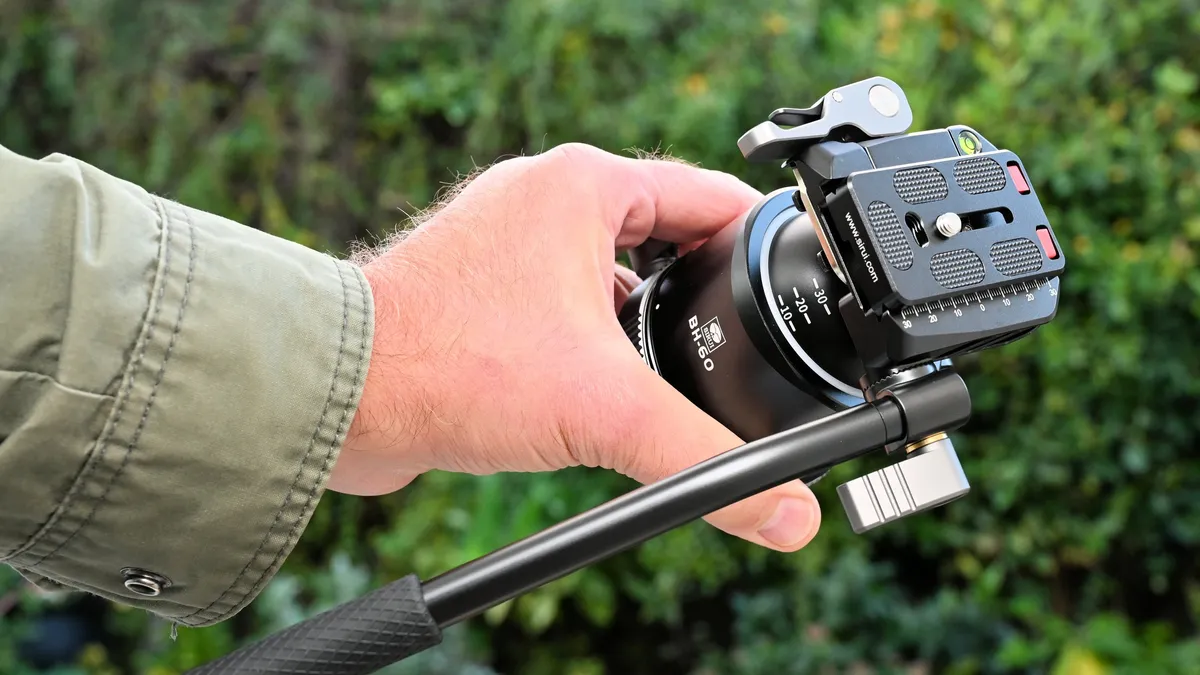
The BH-60 2-in-1 Photo & Video Head that I’m reviewing here aims to be one of the best ball heads as well as one of the best video heads, enabling hybrid shooters to pack and use just one tripod head rather than two, while also enabling a relatively quick, easy, and painless transition between shooting stills and video.
Sirui BH-60 2-in-1 Photo & Video Head: Specifications
Tilt range |
+/-40 degrees |
Panning range |
360 degrees |
Max load rating |
20kg / 44lb |
Base diameter |
68mm / 2.7in |
QR Plate |
Arca-Swiss |
Dimensions (LWH) |
84x90x131mm |
Weight |
950g / 2.1lb |
Sirui BH-60 2-in-1 Photo & Video Head: Price
The Sirui BH-60 2-in-1 Photo & Video Head is priced at $219 / £199 / AU$355. For comparison, the conventional but high-performance Manfrotto XPRO Ball Head with Top Lock (Arca-Swiss) for stills costs around $269 / £193 / AU$400. The more compact, lighter-duty but dual-purpose Benro FS20PRO Video & Foto Head costs just $85 / £100 / AU$215, and the dedicated 3 Legged Thing AirHed Cine CC video head costs $249 / £229 / AU$799. All in all, the Sirui looks competitively priced for the kind of hybrid, heavy-duty head that it is.
Sirui BH-60 2-in-1 Photo & Video Head: Design & Handling
The main claim to fame of the Sirui BH-60 2-in-1 Photo & Video Head, as its name suggests, is that it’s a 2-in-1 hybrid head that’s geared towards both stills and video. That’s potentially great news for hybrid shooters who are perpetually swapping between both disciplines, as they can do so without also needing to keep swapping between two different tripod heads.
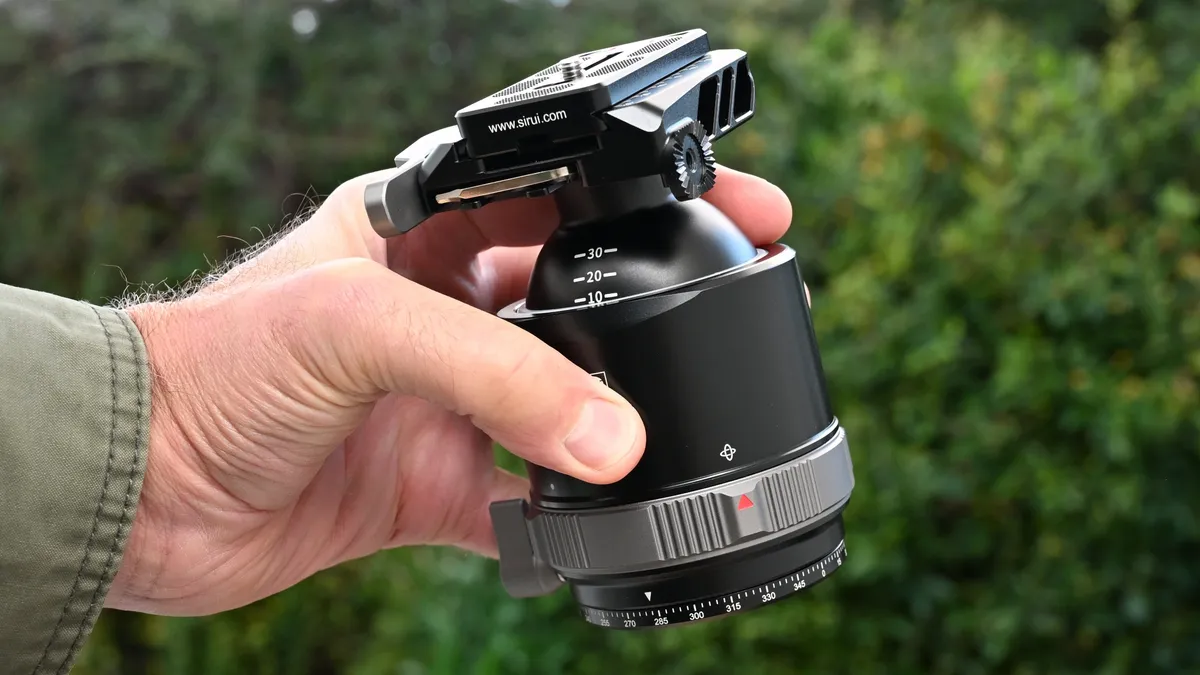
Even so, I’d say that the Sirui is first and foremost a ball head. It’s actually based on an oversized ball and socket with a large 60mm diameter, which helps to ensure smooth movement when you need it, and firm lock-off when you don’t, with minimum sag. The ball is marked front and back with a tilt scale, as shown below, which I feel is reminiscent of the inclinometer you might find in an off-road car or light aircraft.
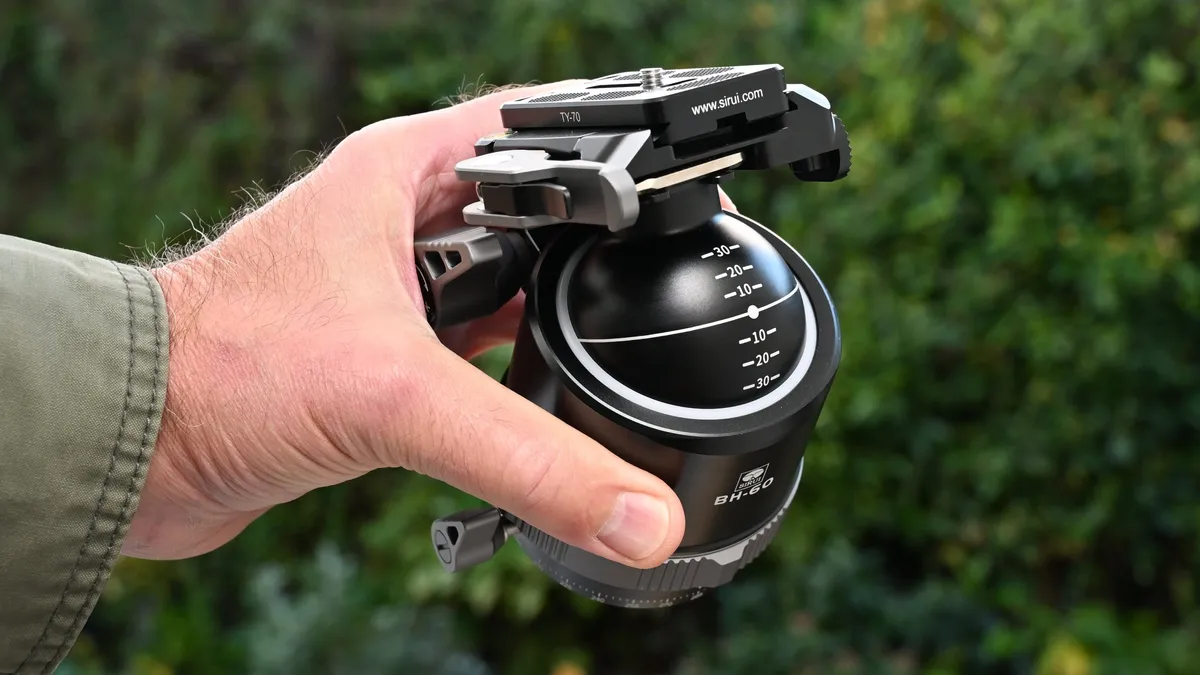
The maximum tilt of the head in any direction is a fairly modest 40 degrees. There’s no notch in the socket, so the amount of forward/backward tilt is relatively limited, compared with most ball heads designed for stills, which typically enable vertical shooting upwards or downwards. It also means that you can’t swivel your camera over on one side to enable portrait orientation shooting, unless you’re using an L-bracket or a cage. As a ‘photo’ ball head and, to an extent, for videography as well, I feel that those are two major omissions on the ‘can-do’ list.
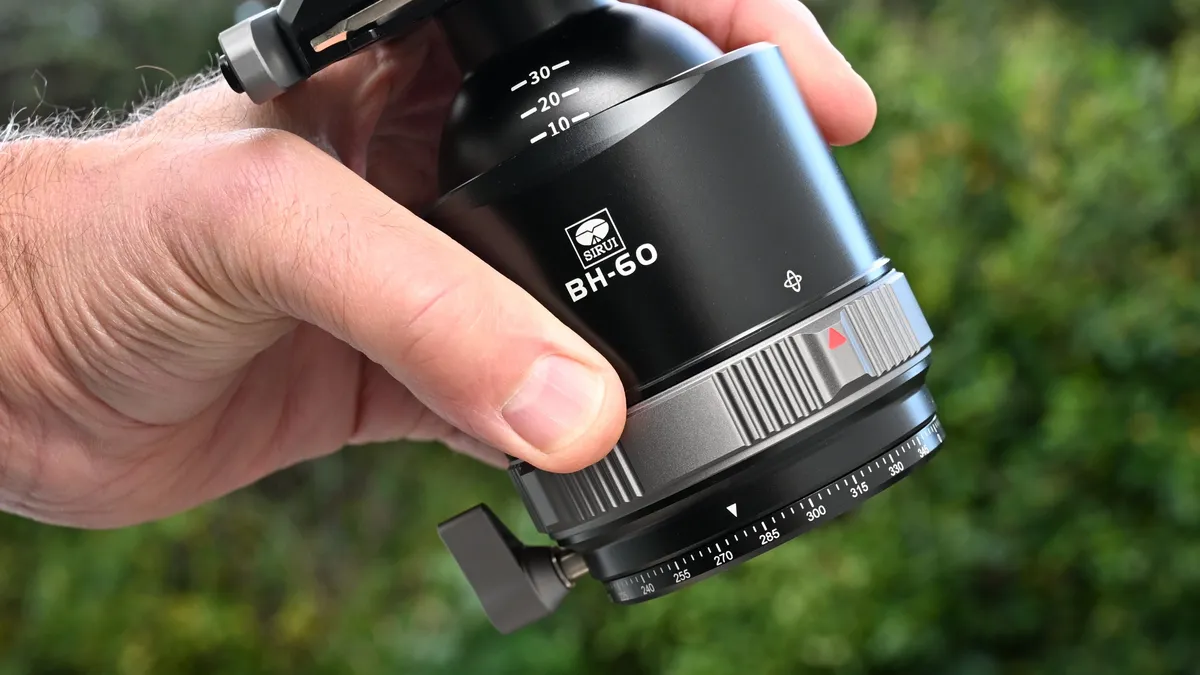
On the upside, the most clever bit of trickery in the hybrid design is the ‘mode selector ring’ just above the base of the head. This is marked in three alternative positions, enabling you to rotate it to engage the appropriate mechanical linkages for the task at hand. The ‘360’ indicates the Photo Mode, which gives you a full and free range of movement, within the tilt limits of the ball head. The interim ‘Transition’ setting is a neutral position that holds the ball more firmly but still fairly lightly, helping to ensure smooth and steady transitions. Finally, the ‘Video Mode’ engages mechanical hard stops for tilt and locks out any lateral roll, so you’re intentionally limited to just tilt and pan movements.
There’s a large locking lever for the ball, and to make sure it’s ideally placed, you can pull it out (it’s spring-loaded) and re-engage it on its 6-sided shaft. Working in tandem with the mode selector ring, the lever works as normal in stills mode, releasing and locking the ball within its socket. In transition and video modes, it also enables you to adjust the amount of drag for the fluid movement of the head, making it easier or firmer to apply positional changes.
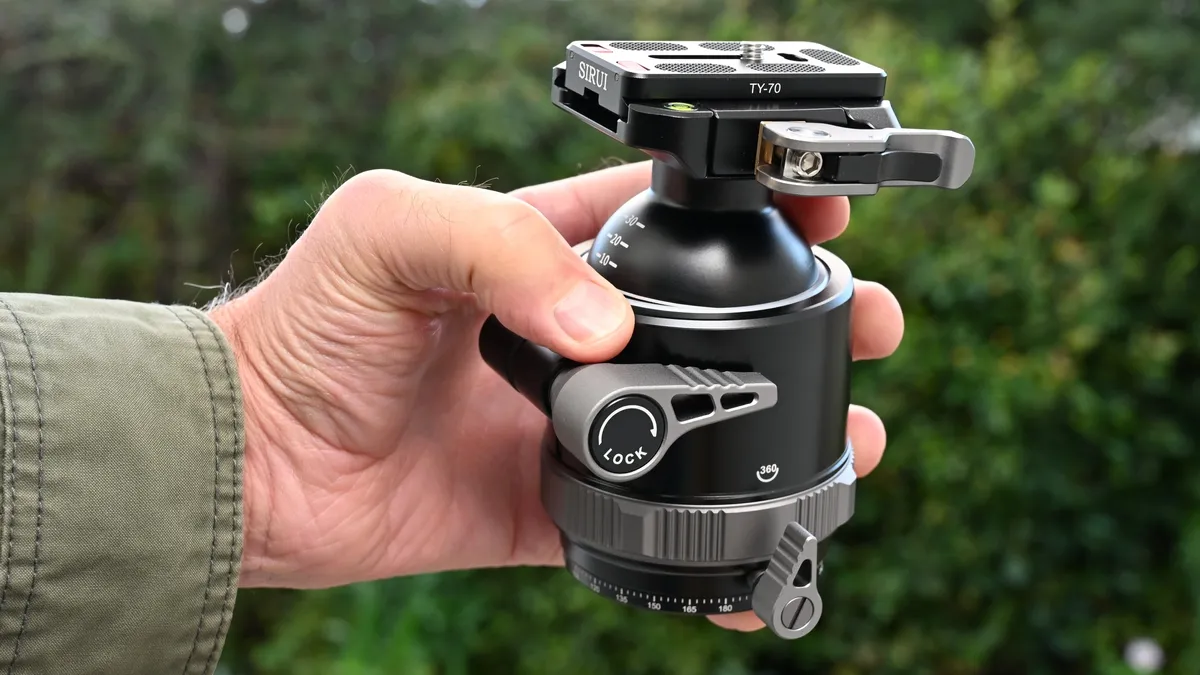
Naturally, any ball-and-socket arrangement is of little use if you want to keep the angle of tilt locked off while still being able to pan. Solving the problem in time-honored fashion, the Sirui has a separate panning base that can be locked or released independently of the ball-and-socket. It relies on a secondary, smaller lever to the main ball-locking lever (shown below) but has the same 6-sided shaft for customizing its rotational placement.
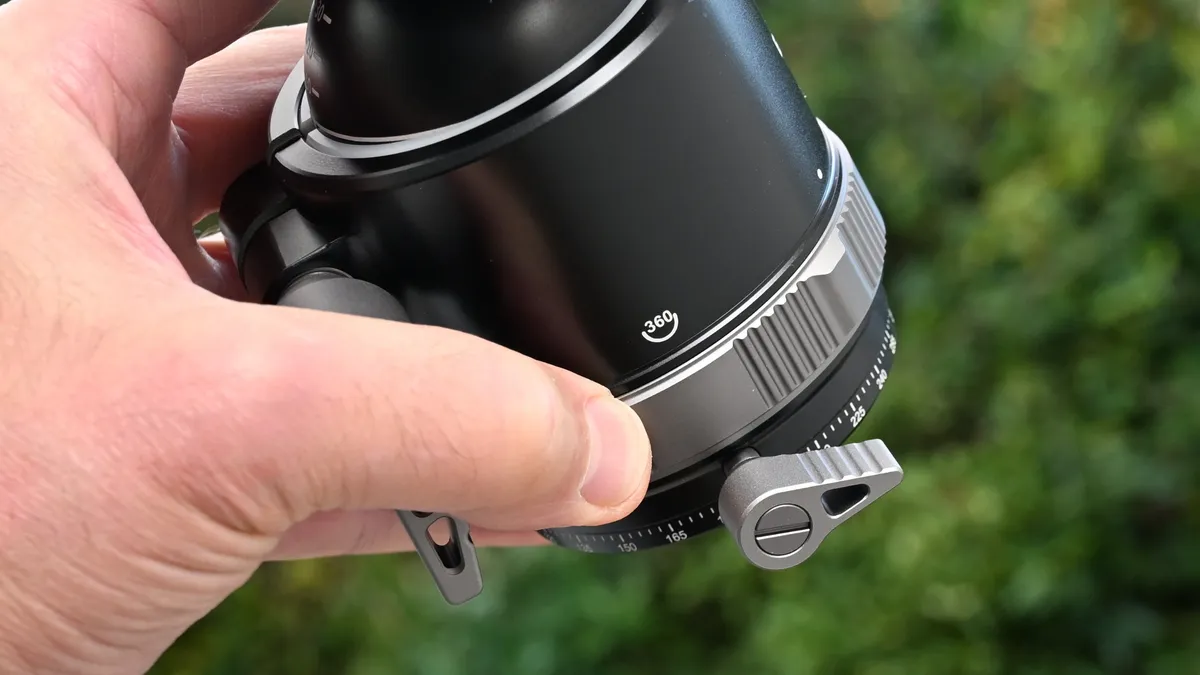
Typical of the panning base arrangement that’s often featured in ball heads, this one has a full 360 degrees of movement and comes complete with a calibrated scale. Numerical markings are shown at every 15 degrees, while interim lines are placed at three-degree intervals. Some video and hybrid ball heads have a secondary panning mechanism at the top, but that’s lacking in the Sirui. I’ll come back to that in a moment.
I’d expect a panning handle to be supplied with any self-respecting video head, and sure enough, the Sirui comes with a 23cm / 9-inch handle. It’s supplied separately so you don’t have to use it if you don’t want to (especially for stills) and fixes in the usual method, secured on splines to avoid any unwanted slippage. It’s also typical to have a bend along its length, so that you can adjust the lateral as well as vertical angle to which the handle is set when attaching it to the head.

Most video heads feature a splined mounting point on both sides, so you can opt to use the panning handle with either your left or right hand. In this case, there’s only a mounting point on the right, so left-handed use is off the menu. That’s a bit of a minus point for me, as I sometimes prefer to pan with my left hand, leaving my right hand free to operate the camera.

The head has a suitably long Arca-Swiss-compatible mounting plate up on top, which helps to fine-tune the balance of an attached camera and lens combination. A further aid to maintaining a natural feel when tilting the head is a 5kg counterbalance spring. This is often omitted in video heads, and while the counterbalance of the Sirui isn’t adjustable, it’s a neat feature that’s nice to have.

To aid with leveling, the mounting plate has a bubble level at the front of the left-hand side. It’s useful up to a point but only serves the purpose of leveling the camera platform rather than the base of the head. The upshot is that if the tripod legs and therefore the base of the head aren’t leveled, and you compensate by leveling the camera platform via the ball and socket, your horizon will start to tilt as soon as you start panning. This is why some video-friendly heads have a secondary panning mechanism at the top to keep the horizon level, which also works well for shooting a sequence of stills for stitching into a panoramic image.

To solve the problem of leveling, some video heads have a built-in leveling base, but this one doesn’t have one. To avoid the time-consuming and tricky chore of leveling the tripod legs by adjusting their various sections, you could add a separate leveling base. Sirui offers its own AM-60LE Levelling Head for the purpose, while alternatives include the 3 Legged Thing LevelHed and Vanguard LVL Universal Tripod Levelling System.
Getting back to what’s actually part of the head, it features a safety-conscious quick-release plate locking lever. You need to depress a safety catch before you release it, and even then it only moves through 90 degrees to start with. This enables you to move the QR plate forwards or backwards, without any danger of it dropping out altogether. To completely remove the QR plate, you need to fully rotate the locking lever through 180 degrees.

The safety system of the QR plate not being able to slide out forwards or backwards comes courtesy of two small hex screws, shown in the picture below. However, this makes the platform incompatible with some Arca-Swiss QR plates and lenses that have an Arca-Swiss profile foot on their tripod collars. If needed, you can remove the two safety screws using the supplied hex key.

Another operational security feature is that the QR plate features pop-up red lugs at one end. You can engage these and fit them flush against the front or rear of your camera body, or the mounting plate of a large lens. They’ll then reduce the risk of the camera unwantedly twisting on the QR plate, especially when you’re panning in an anti-clockwise direction. It’s a neat solution to a common problem, especially when shooting video or when trying to track fast-moving objects, even if you’re shooting stills.

The QR plate has a D-ring on its mounting screw, so you can attach a camera by twisting the screw with your finger and thumb. For properly securing your camera, it’s much better to use a hex key or coin. As such, the head is supplied with a dual-size hex key for this purpose, as well as for removing the safety screws from the platform, if necessary. The tool tucks into the rear of the platform and is secured by two small disk magnets, visible in the image below.

The head is supplied complete with a drawstring pouch that feels of good quality. However, it’s a lot longer than it needs to be, because it’s designed to hold the panning handle as well as the head itself. The stowage size could have been reduced if the handle had a telescopic design, but that’s not the case.

Sirui BH-60 2-in-1 Photo & Video Head: Performance
The Sirui BH-60 2-in-1 Photo & Video Head covers the basics in fine style. The ball and socket offer effortless movement when shooting stills, coupled with firm positional locking and minimal sag after tightening the locking lever and letting go of your camera. Switch to video, and you’re rewarded with a pleasant, fluid motion for pan and tilt, and the bonus of the 5kg counterweight system. The red pop-up anti-twist lugs on the QR plate are another little performance asset when panning for either stills or video.

Ultimately, however, I feel that the performance of the Sirui head is somewhat compromised. The lack of a notch in the ball socket results in a maximum tilt angle of just 40 degrees. This makes vertical upward or downward shooting impossible, and you might feel that the outright range is somewhat restrictive even for general shooting.

Further limiting factors are that the head doesn’t include a leveling base, so you need to add one separately (at an additional expense) to enable easy setup. Without a leveling base or a secondary upper panning mechanism, it can be a real chore to level the legs on uneven terrain so that your horizon stays true when you start panning. And getting back to the lack of a notch in the socket, the ball head design also means that you can’t swivel your camera for portrait (upright) orientation shooting unless you add another separate component in the shape of a cage or L-bracket.

Sirui BH-60 2-in-1 Photo & Video Head: Verdict
The Sirui BH-60 2-in-1 Photo & Video Head is like a game of two halves, and not in an altogether good way. I’m all for saving weight, stowage size, and expense when it comes to the kit that I need to carry around and use. The prospect of a 2-in-1 head that works equally well for shooting both stills and video therefore looks a very attractive proposition. As well as savings in size, weight and expense, there’s also the added convenience of not having to keep swapping the head on my tripod, or having to use two completely separate tripod kits.
Fulfilling its promise in part, I feel that the Sirui enables quick and easy setup for stills, with simple positional adjustments and firm locking with minimal sag. Similarly, the fluid pan and tilt modes work well for shooting video, complete with a 5kg counterweight system that adds refinement.
The inclusion of three different stills, video, and transitional modes does, however, come with compromises. The +/-40 degrees tilt and swivel range makes it impossible to shoot upwards or downwards at anything more than modest angles, and takes portrait orientation shooting off the agenda, unless you add a cage or L-bracket. There’s also no built-in leveling base for panning, nor a secondary upper panning mechanism. Ultimately, I think the Sirui is a good head that performs well (within its limitations), but it’s not entirely great.
Features ★★★★☆ |
Intriguing features include a 3-position mode selector ring for stills, video or ‘transitional’ shooting. The 5kg counterbalance system is another nice feature. |
Design ★★★★☆ |
The design enables genuine dual-mode stills and video usage, but with compromises in the amount of tilt and lack of portrait orientation shooting. |
Performance ★★★★☆ |
With no leveling base nor an secondary upper panning mechanism, setup can be a chore but the head works well for both stills and video, within its tilt limitations. |
Value ★★★★☆ |
Quite a lot of mechanical engineering has gone into this hybrid head, and build quality is good, making the Sirui competitively priced. |

Alternatives