


A sheet of yellow paper is taped to a dashboard, with an empty highway stretching off into the distance. The handwriting reads: "Roxham Road. Border/Frontera $90 each/Family. College $15 each."
Ruth Kaplan took this picture in 2021 on Interstate 87, in a cab running from the bus station in Plattsburgh, New York, to the Canadian border.
For several years, thousands of asylum seekers made that half-hour ride to Roxham Road, a rural road that runs north from the town of Champlain, in upstate New York, to Saint-Bernard-de-Lacolle in Quebec.
Where the two nations meet, they got out and walked across. The crossing wasn’t an official port of entry, but by 2017 it had become a de facto route into Canada for asylum seekers.
Kaplan, a documentary photographer from Toronto, first went there in December 2018. She went on to make a dozen trips before the site closed in 2023. Now, Crossing, a new book from Kehrer Verlag, brings together her pictures of this place.


As art historian Sarah Bassnett notes in one of the essays, there are no "images of people clambering over fences or fleeing law enforcement" within these pages.
Instead, we see shots of luggage roped onto the back of a car, a woman with a suitcase on a snow-lined road and a page of handwritten Creole, discarded on the ground.
An ordinary place
But why were the asylum seekers here, in this out-of-the-way place?
Well, under the Safe Third Country Agreement, most people arriving from the US couldn’t claim asylum at official crossings. Yet anyone who'd already made it onto Canadian soil was entitled to have their claim heard in Canada. Roxham Road offered a way to do that, because you could simply walk across.
It played out like this. Canadian border officers would tell new arrivals, while they were still on the US side, that this wasn’t a legal port of entry and that they’d be arrested if they crossed. Each person had to acknowledge the warning.
Those who chose to continue then stepped into Canada, walked into the border building and started their refugee claim, a long process that often began with their bags being searched.
Numbers rose during Donald Trump’s first presidency, until the two countries amended the agreement in 2023 and the crossing was shut down.


Martine Fourcand, an artist who assisted Kaplan, compared this small patch of ground to a stage, with everyone (border guards, cab drivers, refugees) playing their roles. But that didn't make it feel routine.
"Over the next few years, I watched the scene unfold over and over, but it never felt normal," Kaplan writes. "I never got used to it."
The photographer had a particularly personal connection to her subject matter: her mother survived a concentration camp.
"The elders I grew up around, including my parents, made a home in Canada after fleeing Eastern Europe and the Holocaust," she explains. "This likely explains the familiarity I felt among the broadly diverse asylum seekers."
Through the seasons
What strikes me about these pictures is how the settings change. In summer, a family waits among tall wildflowers and two officers stand surrounded by lush green foliage.
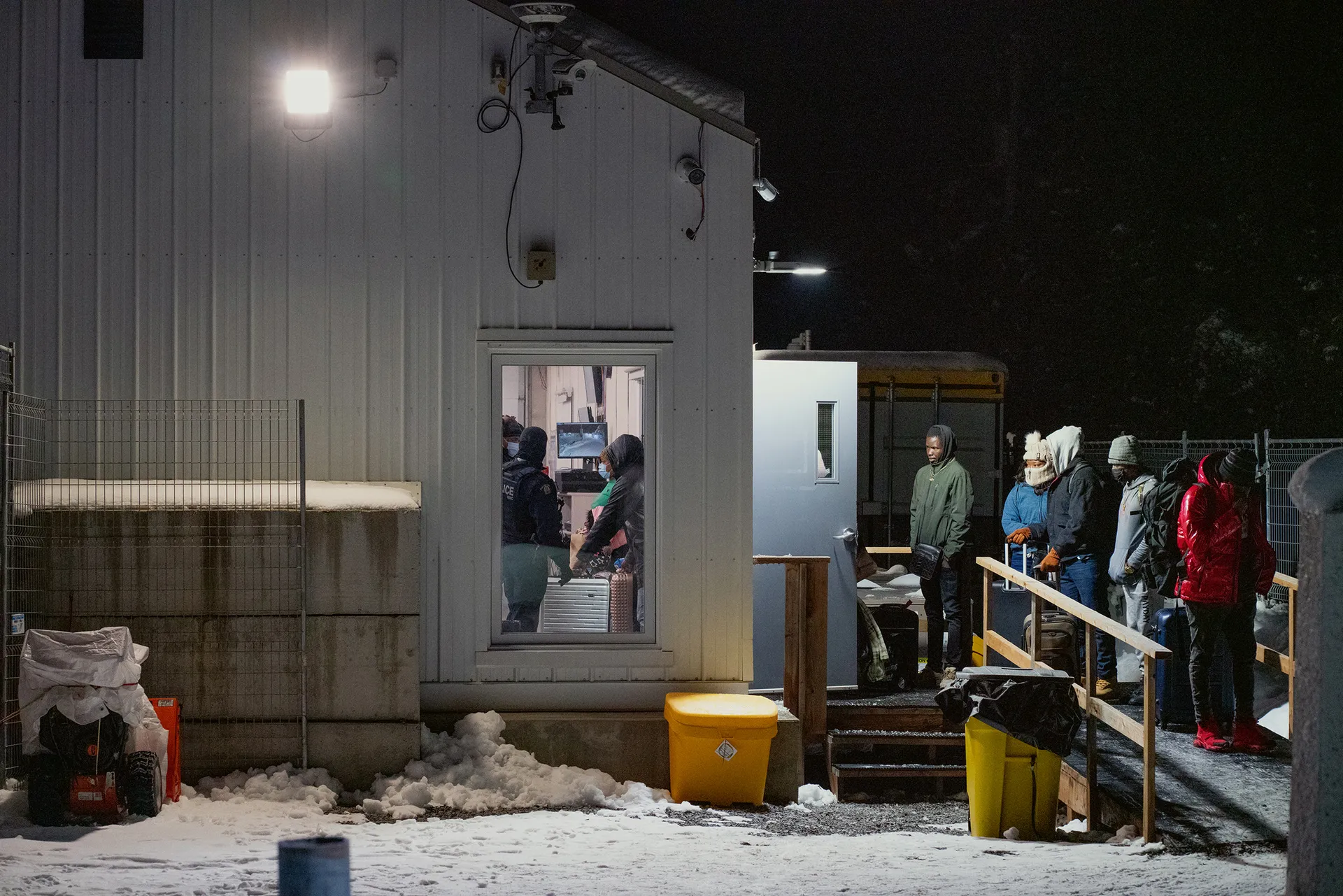
In winter, floodlights and taillights turn the same patch of ground into something much more unsettling, as people unload their bags in the snow and line up outside a floodlit building studded with security cameras.
Between the pictures, we get fragments of interviews with people who crossed, spaced out on the page like poems. "It was snowing! Everything was white," one recalls. "That was the first time I've seen snow."
As for Roxham Road today, you'd never know any of this had happened. "I have been back to the site a few times since its closure in 2023," says Kaplan. "It reveals no trace of what was."
Crossing: From USA to Canada, Walking Roxham Road by Ruth Kaplan is published by Kehrer Verlag. Costing $50 / £32, it's a 176-page hardcover measuring 24.5 x 16.5cm, with texts by Kaplan, Bassnett, refugee lawyer Raoul Boulakia and Afghan journalist Habib Zahori.
You might also like…
Check out more of the best books on photography.

